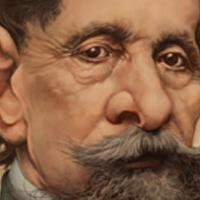
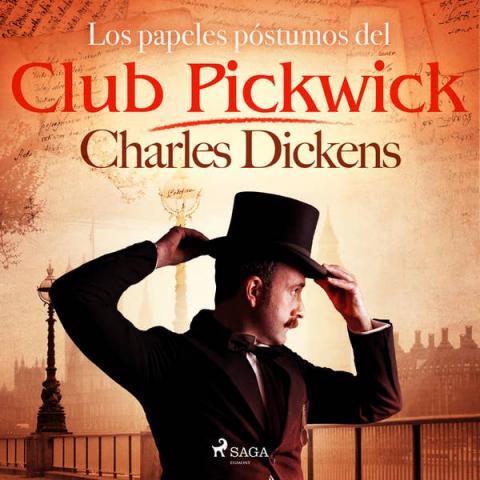
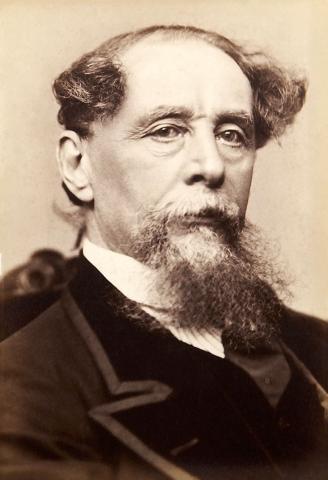
Charles John Huffam Dickens (Inglaterra, 1812–1870), es uno de los más famosos novelistas ingleses. Clasificado como autor infantil por sus novelas Oliver Twist, David Copperfield y Canción de Navidad, entre otras, también era un socarrón de las clases sociales de su época, como dejó claro en los Papeles póstumos del Club Pickwick (1836–1837), una de sus menos conocidas obras, a pesar de que en su momento fue de tal éxito que, según las crónicas, no faltaron los lectores que nombraron a sus hijos y mascotas como los personajes de Pickwick. Sin dejar su mirada burlona, logró un serio ejercicio narrativo, pues sus personajes describen aspectos profundos del pueblo británico, y, en tal medida, de toda la humanidad. En pleno siglo XXI, donde el manejo de lo visual hace pesada la lectura de largas descripciones, Dickens sobresale por lograr mostrar escenarios con pocas palabras y por hacer que las acciones de sus personajes sean más elocuentes que los diálogos burlescos a que los somete. Aquellos terminaron por germinar en el imaginario popular de su tiempo y ahora siguen funcionando como toda buena literatura, con todo y que en su tiempo tales personajes fueron catalogados como grotescos.
Esto nos pone en la disquisición de establecer si el humor debe corresponder a una etapa social en un lugar y en un tiempo determinado, o si el humor llamado importante debe funcionar en cualquier momento y ante cualquier lector. Sin duda, el tener frescos los referentes humorísticos hace más disfrutable el ingenio del autor, pero el problema de leer en otro siglo y sin los referentes adecuados, es que se requiere tener la información completa para comprender el chiste. No es que el humor decaiga, es que el lector tiene la responsabilidad y debe contar con la información completa para que el chiste sea vigente; en este tiempo, en donde el consumidor desea que todo sea simple, rápido y de fácil consumo, pareciera que es responsabilidad del oferente del producto humorístico que el lector comprenda lo que se le ofrece, cuando la realidad es que el consumo cultural, como cualquier otro consumo, presupone al consumidor capaz de hacer un comparativo de precios, de calidad en el producto y en su desempeño, de garantías y, en estos tiempos de aranceles sacados del teatro del absurdo, hasta del país donde se produjo el bien que se ha de consumir. Y lo mismo sucede con el humor, ya sea leído, visto o escuchado: el consumidor también tiene una responsabilidad, de ahí la existencia de muchas editoriales que publican textos comentados, con tantas referencias, ya sea en pie de página o en un anexo, que duplican el tamaño de la edición, pero que sirven para que el consumidor entienda mejor lo que está leyendo y, de ser el caso, puede reírse con la misma información que se reían los lectores de Dickens el milenio pasado. Lo mismo sucede con el concepto de lo grotesco, podrán cambiar las referencias para establecer qué es agradable a la vista y qué repudia al espectador, pero si el lector de lo humorístico antiguo es incapaz de investigar, considerar o recabar los datos del objeto de la burla, la culpa de la ineficacia del chiste grotesco no residirá en el emisor sino en el receptor que en su estulticia cómoda deja en manos de los autores reconocidos el que logren sorprenderlos. Las llamadas generaciones de cristal se ofenden cuando se les tilda de ignorantes o de flojos, pero ciertamente lo son en temas culturales. El extremo de esta necedad es censurar obras que en su momento fueron consideradas como mayores, pero bajo la óptica actual sin la información completa. Los censores no entienden lo que ven porque son ignorantes, no porque el producto sea reprochable. Cualquiera que comprenda que la esclavitud era un acto social aceptado por todos los usuarios de la figura hoy prohibida, entenderán qué haya novelas donde los esclavos sean capaces de dar las gracias por no haber sido maltratados. Establecer que los esclavos de hace unos siglos tengan la misma indignación que hoy se tiene por el maltrato, el abuso y los muchos crímenes cometidos en las personas secuestradas del continente africano, es una postura desinformada, por decir lo menos. Si el humor puede hablar de todo, más se puede reír de los ignorantes incapaces de comprenderlo por su propia estulticia y su inmovilidad mental.
El Club Pickwick, como casi todas las novelas de Dickens, se publicó por entregas. Inicialmente contratado para escribir los pies de página de las ilustraciones del entonces famoso Robert Seymour, terminó por imponer sus términos y su calidad, sustentada en tremendas ventas, para escribir por dos años las aventuras del señor Pickwick, un regordete burgués bienintencionado, que desea asentar el conocimiento que tiene del mundo a su alrededor. Quien conozca la biografía de Dickens entenderá que esto es muy humorístico, pues el autor en realidad poco se preocupaba de su apreciación personal del mundo como referente social. Lo que sí nos llama es a saber el tipo de literatura que divertía el autor. El gusto de Dickens por la picaresca puede verse en el tratamiento humorístico de lo narrado; algunos críticos de su tiempo lo hacen lector del Quijote: incluso, Pickwick y sus secuaces fueron comparados con el Hidalgo y su Sancho Panza. Difícil se antoja la comparación, pues Pickwick, con todo y su inocencia, vive el momento y no lucha con molinos de viento. Se elogia el Quijotepor sus apreciaciones sobre el deber ser, cuando que Pickwick habla más del ser, de ahí su tono Humorístico, pero sin poner en Boca de sus personajes como debería ser la sociedad o qué actitudes deberían tomar ciertas personas, como es el Quijote en varios momentos de la enorme novela, para decirle a Sancho los pasos a seguir. O incluso es el propio Sancho el que establece la forma en que deberían funcionar los hostales y como debe tratarse a las demás personas. Pero esta es una diferencia central entre Dickens y el manco de Lepanto. Dickens se limita a describir el comportamiento de los integrantes de ciertas clases sociales para lograr divertir al lector. Además, claro está, de qué Dickens si murió con las dos extremidades superiores completas.
A pesar de su difícil infancia y de conocer en carne propia cómo vivían las clases proletarias, en Pickwick brinca el carácter de un escritor que incluso retrata con sorna a los vivales pobres: es un escritor que se burla de las clases representadas por sus personajes, al mostrarlos en sus principales defectos, muchos de clase, otros de edad o de género. Pero no hay una mirada clasista, ni hacia arriba ni hacia abajo. Lo mismo son risibles las solteronas con dinero que las sufrientes esposas proletarias; igual de hilarantes son los adinerados puritanos, que los lacayos de corta visión. De las profesiones, también se puede afirmar que las relevantes de su tiempo pasaron por el cuchillo del humor denostativo: los militares hacen maniobras, para su lucimiento y “ejercicio”, ante los civiles, pero son incapaces de respetar a los espectadores y Pickwick y acompañantes terminan corriendo entre balas de salva y balas verdaderas. El choque entre el discurso y las acciones suele llamar a la risa, como demuestran los políticos de toda la latitudes, donde dicen una cosa y hacen la otra. Las educandas de los colegios para señoritas (en la era victoriana, no olvidar) son incapaces de ver a un hombre (aunque sea el propio Pickwick, a quien los lectores sabemos honesto y respetuoso a toda prueba) sin suponer que habrá de robarlas o vejarlas. Por supuesto, los abogados y sus eternos litigios son motivo de divertimento. Aunque no sólo por las pillerías de los “letrados”, sino por factores filosóficos: Pickwick le reclama a su comparsa Sam que pague la deuda, que además es pequeña, pero Sam argumenta no estar dispuesto a hacerle un favor al acreedor por darle lo adeudado: Sam estima que no todo el mundo merece cobrar. Para los abogados esto es una broma trascendental: la esencia de la acreedor es aquel que tiene todo el derecho a cobrar, porque justamente le deben un pago. Y aquí en la risa vamos a cuestiones de neurociencia porque si el nombrar algo por su función es rebatido en el argumento de Dickens como qué se le debe negar la esencia ,de cobrar la deuda se comprende, entonces este acreedor ha dejado de serlo y en consecuencia de existir. Decir que no todos tienen derecho a existir llama al absurdo y da risa.
Pero el factor común es la interioridad de los británicos, proclives a cuidar las formas y las apariencias, al grado de ponerse en ridículo con tal de no quedar mal en público. Ya tendría tiempo en sus posteriores novelas para tratar los mismos temas con seriedad, claramente con el sentido de afectar el sentimentalismo de sus lectores. Aspectos que le fueron criticados, entre otros, por el propio Chesterton, considerado uno de los principales humoristas de la época. Las formas son importantes, de ahí que uno de sus personajes hable casi en clave, con oraciones entrecortadas, entremezclando sentidos y sustantivos, en una forma que nos recuerda al peladito clásico, que en el Cantinflas inicial logra una cumbre mundial, y que a pesar de sus pocos centavos logra burlarse de ricos y estudiados, incluso engatusando a una solterona para luego recibir dinero a cambio de devolverla al pretendiente burlado. Precisamente el lenguaje de aquél llama la atención de Picwick, pero pronto advierte que sólo es una muestra de la inteligencia encaminada a vivir a costa de los demás. Hay un ayudante que literalmente vive y trabaja dormido y que sólo despierta para comer o para cobrar dinero. Los personajes burlescos se disparan y hasta un perro que es motivo de divertimento al darle características humanas, pues según el humor de Dickens éste animal resulta lector por no querer entrar a un terreno de caza que tiene el anuncio de que los perros que ahí se encuentren serán baleados. Si ya es risible que los perros puedan leer, mas risa da que tenga la inteligencia para obedecer lo que no le conviene.
Dickens tenía la creencia, al menos literaria, de que el bien al final siempre vence; así, Pickwick sale airoso de sus encuentros con la desventura y la adversidad, pero ese afán no deja de ser burlesco. Aún en el tema de los fantasmas, entonces de moda, el humor impera: ante el fantasma que limita el alquiler de departamentos, el personaje le sugiere que, puesto que para los fantasmas el tiempo y la distancia no importan, le convendría irse a un lugar con mejor clima y entretenimientos, y mejor si puede llevarse a los fantasmas de otras propiedades arrendadas. A lo cual el espíritu chocarrero accede, tras reconocer que no se le había ocurrido tan buena idea.
La visión de Dickens sobre la Gran Bretaña en su época de mayor poder militar, con su doble discurso de rectitud extrema y abuso ilimitado en los sojuzgados, resulta reveladora y asesta un golpe de histrionismo (con Pickwick) para recordarnos que incluso en la adversidad, el humor es una opción viable, quizá la mejor. Sobre todo si es el de un burlón empecinado. En los tiempos que corren donde los Estados Unidos de América actúa con el poder de las armas por encima de leyes internacionales, con motivos muy opinables que tendrán seguidores y detractores quizás en igual cantidad, la lectura de Pickwick ofrece una forma distinta de mirar lo que para algunos es el inicio de la decadencia mundial y que para otros es sólo un motivo más para divertirse con el sufrimiento personal de Maduro, quien retaba confiado al presidente estadounidense, cierto de qué jamás sería detenido, pero que ahora es visto en parte del mundo como una persona que sufre en carne propia los excesos que cometió respecto de otros.
El entorno social (de la localidad, del país y hasta del continente europeo) de los papeles de Pickwick, el tino humorístico de Dickens y la posibilidad de situar en un contexto contemporáneo los choques sociales y conceptuales de sus personajes resulta motivo suficiente para decir que el humor burlón y crítico de Dickens ha resistido el cambio de dos siglos y de un milenio.
Charles Dickens
Dickens, the mocking one
By Ricardo Guzmán Wolffer
Charles John Huffam Dickens (England, 1812–1870) is one of the most famous English novelists. Classified as a children’s author because of novels such as Oliver Twist, David Copperfield, and A Christmas Carol, among others, he was also a sharp mocker of the social classes of his time, as he made clear in The Posthumous Papers of the Pickwick Club (1836–1837), one of his lesser-known works despite the enormous success it enjoyed in its day—so much so that, according to contemporary chronicles, many readers named their children and even their pets after Pickwick’s characters. Without abandoning his mocking gaze, Dickens achieved a serious narrative exercise, since his characters portray profound aspects of the British people and, to that extent, of all humanity. In the twenty-first century, when the predominance of the visual makes the reading of long descriptions seem burdensome, Dickens stands out for his ability to depict settings with few words and for making the actions of his characters more eloquent than the burlesque dialogues to which he subjects them. These characters ultimately took root in the popular imagination of their time and continue to function today as all good literature does, even though in their own era they were classified as grotesque.
This leads us to the question of whether humor must correspond to a specific social stage in a particular place and time, or whether so-called “important” humor should function at any moment and for any reader. Undoubtedly, having fresh humorous references makes the author’s ingenuity more enjoyable; however, the problem of reading in another century and without the appropriate references is that one needs complete information in order to understand the joke. It is not that the humor decays; rather, the reader bears the responsibility of having sufficient information for the joke to remain effective. In an age in which consumers desire everything to be simple, fast, and easily digestible, it seems that the responsibility falls on the provider of the humorous product to ensure that the reader understands what is being offered. Yet the reality is that cultural consumption, like any other form of consumption, presupposes a consumer capable of comparing prices, quality, performance, guarantees, and—these days of tariffs seemingly drawn from the theater of the absurd—even the country where the product to be consumed was produced. The same applies to humor, whether read, seen, or heard: the consumer also bears responsibility. Hence the existence of many publishers that release annotated editions, with extensive references in footnotes or appendices that double the size of the book, but allow the consumer to better understand what they are reading and, if appropriate, to laugh with the same information that made Dickens’s readers laugh a millennium ago.
The same occurs with the concept of the grotesque: references may change to determine what is pleasing to the eye and what repels the viewer, but if the reader of old humorous works is incapable of researching, considering, or gathering information about the object of mockery, the fault for the inefficacy of the grotesque joke does not lie with the sender but with the receiver, who in their comfortable obtuseness leaves it to canonical authors to manage the task of surprising them. The so-called “crystal generations” take offense when they are labeled ignorant or lazy, but in cultural matters this is often the case. The extreme of this foolishness is censoring works that were once considered great, judging them through a contemporary lens without complete information. Censors do not understand what they see because they are ignorant, not because the work is reprehensible. Anyone who understands that slavery was once a socially accepted institution will grasp why novels exist in which enslaved people are capable of expressing gratitude for not having been mistreated. To demand that enslaved people from centuries past display the same indignation we feel today toward abuse, exploitation, and the many crimes committed against people kidnapped from the African continent is, to say the least, an uninformed stance. If humor can speak about everything, it can all the more readily laugh at those ignorant individuals incapable of understanding it due to their own obtuseness and mental immobility.
The Pickwick Club, like almost all of Dickens’s novels, was published in installments. Initially hired to write captions for illustrations by the then-famous Robert Seymour, Dickens ultimately imposed his own terms and quality—supported by tremendous sales—to write, over the course of two years, the adventures of Mr. Pickwick, a well-intentioned, portly bourgeois eager to systematize his understanding of the world around him. Anyone familiar with Dickens’s biography will recognize the humor in this, since the author himself cared little for using his personal worldview as a social reference. What does stand out is the kind of literature that amused Dickens himself. His taste for picaresque narratives is evident in the humorous treatment of what he recounts; some critics of his time even considered him a reader of Don Quixote, and Pickwick and his companions were compared to the Knight of La Mancha and Sancho Panza. The comparison seems difficult, however, since Pickwick, despite his innocence, lives in the present and does not battle windmills. Don Quixote is praised for its reflections on how things ought to be, whereas Pickwick speaks more about how things are—hence its humorous tone—without placing in his characters’ mouths prescriptions about how society should function or what attitudes people ought to adopt, as Cervantes does in various moments of his monumental novel when Don Quixote instructs Sancho on the proper course of action, or when Sancho himself lays down rules about how inns should operate and how people ought to be treated. This is a central difference between Dickens and the one-armed man of Lepanto. Dickens limits himself to describing the behavior of members of certain social classes in order to amuse the reader. And, of course, Dickens died with both upper limbs intact.
Despite his difficult childhood and his firsthand knowledge of proletarian life, Pickwick reveals the character of a writer who even portrays poor rogues with irony. He mocks the classes represented by his characters by exposing their principal defects—some class-based, others related to age or gender. Yet there is no classist gaze, neither upward nor downward. Wealthy spinsters are just as laughable as suffering proletarian wives; affluent puritans are as hilarious as short-sighted lackeys. Professions, too, were subjected to the knife of denigrating humor: soldiers perform maneuvers for their own display and “exercise” before civilians, yet they are incapable of respecting spectators, and Pickwick and his companions end up running amid blank shots and live ammunition. The clash between discourse and action naturally provokes laughter, as politicians across all latitudes demonstrate when they say one thing and do another. Students at girls’ boarding schools (in the Victorian era, let us not forget) are incapable of seeing a man—even Pickwick himself, whom readers know to be scrupulously honest and respectful—without assuming he intends to abduct or assault them. Lawyers and their endless litigation, of course, are a source of amusement, not only for their trickery but also for philosophical reasons: Pickwick insists that his companion Sam pay a small debt, but Sam refuses to do the creditor the favor of paying, arguing that not everyone deserves to be paid. For lawyers, this is a fundamental joke: the essence of a creditor lies precisely in having the right to collect what is owed. Here laughter enters the realm of neuroscience, because if naming something by its function is challenged—as Dickens does by denying the creditor the essence of collecting a debt—then the creditor ceases to exist. To say that not everyone has the right to exist leads to absurdity and provokes laughter.
The common thread, however, is the inner life of the British, inclined to preserve appearances to the point of making fools of themselves rather than losing face in public. In later novels Dickens would address these same themes more seriously, clearly aiming to affect his readers’ sentimentalism—an aspect criticized by figures such as Chesterton, himself considered one of the great humorists of the era. Form matters, which is why one of Dickens’s characters speaks almost in code, with broken sentences and mixed meanings and nouns, in a manner reminiscent of the classic peladito archetype later elevated to global fame by early Cantinflas. Despite his poverty, this character manages to mock the wealthy and educated, even tricking a spinster and receiving money to return her to her humiliated suitor. This language initially attracts Pickwick’s attention, but he soon realizes it is merely a manifestation of intelligence devoted to living off others. There is also an assistant who literally lives and works while asleep, waking only to eat or collect money. Burlesque characters abound, including even a dog made humorous by being given human traits: according to Dickens’s humor, the animal appears to be a reader because it refuses to enter a hunting ground marked with a sign warning that dogs found there will be shot. If the idea that dogs can read is laughable, even more amusing is the notion that one would be intelligent enough to obey what does not suit it.
Dickens held, at least in literary terms, the belief that good ultimately triumphs; thus, Pickwick emerges victorious from encounters with misfortune and adversity, though this aspiration itself retains a mocking tone. Even in the then-fashionable theme of ghosts, humor prevails: when faced with a ghost that limits apartment rentals, a character suggests that, since time and distance are irrelevant to spirits, it would be better for the ghost to move to a place with a better climate and more entertainment—preferably taking along the ghosts from other rented properties. The mischievous spirit agrees, acknowledging that such a good idea had never occurred to it.
Dickens’s vision of Great Britain at the height of its military power—with its double discourse of extreme rectitude and limitless abuse of the subjugated—is revealing. Through a stroke of theatricality (embodied in Pickwick), he reminds us that even in adversity, humor is a viable option—perhaps the best one—especially when it belongs to a stubborn mocker. In our present times, when the United States of America often acts through military power above international law, for highly debatable reasons that attract both supporters and detractors in equal measure, reading Pickwick offers a different way of viewing what some see as the beginning of global decline and others as merely another opportunity to laugh at the personal suffering of Maduro, who once confidently challenged the U.S. president, certain he would never be detained, but who is now seen in parts of the world as someone experiencing firsthand the excesses he inflicted upon others.
The social environment—local, national, and even continental European—of The Pickwick Papers, Dickens’s keen sense of humor, and the possibility of situating the social and conceptual clashes of his characters within a contemporary context are more than sufficient reason to assert that Dickens’s mocking and critical humor has withstood the passage of two centuries and an entire millennium.
(This text has been translated into English by ChatGPT)